
 English (UK)
  Polish
  English (United States)
  French
  German
  Swedish
  Italian
  Spanish
  Czech
Czech  Slovak
  Indonesian
  Hungarian
  Romanian
  Portuguese
  Bulgarian
  Lithuanian
  Latvian
  Slovenian
  Danish
  Finnish
  Estonian
  Dutch
Dutch  Arabic
  Japanese
  Korean
 What do we do?
We make chemical reagents available for purchase.
The range of chemical/laboratory reagents is aimed at institutions and individuals, scientists and chemistry enthusiasts wishing to conduct research and scientific experiments in a professional as well as a home laboratory.
Tested in a Polish certified laboratory.
A proprietary method of peptide production.
Robust and aesthetically pleasing packaging.
We select only the most interesting substances.
Free delivery within Poland from £200 when paying in advance.
Same day dispatch for orders placed by 11am.
We send parcels all over the world.
100% secure payment methods. Blik and fast transfer, card, GPay, ApplePay.
Carefully selected products.
You have 14 days to return the goods.
Our products


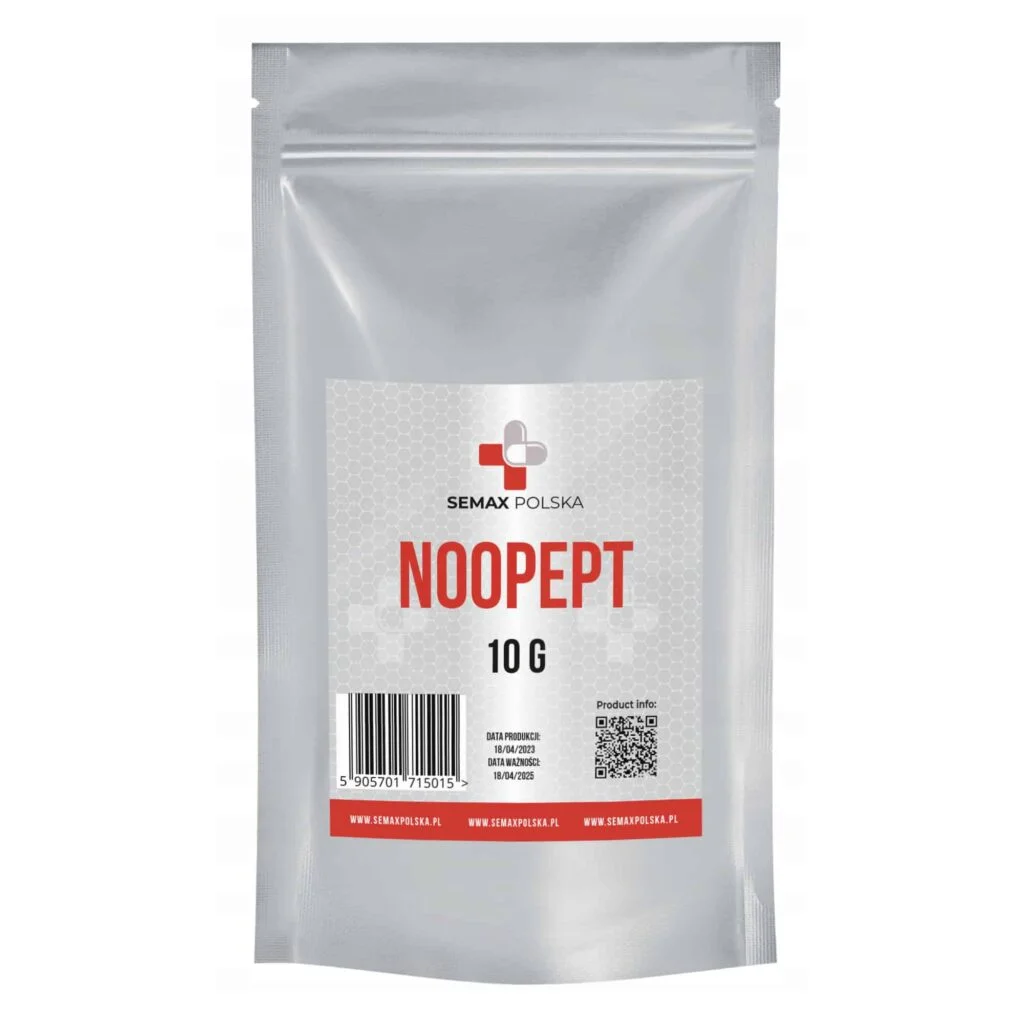


The best chemical reagents on the market.
We offer chemical reagents for laboratory use.
Feedback from our customers
The most interesting peptides in our range – substance information
Our range includes synthetic peptides, peptide complexes and other compounds intended for laboratory and research applications.
Below we present the characteristics of selected substances, including their nomenclature, amino acid sequence, chemical structure, molecular weight, CAS numbers and information regarding the chemical forms present.
Poszczególne parametry mogą różnić się w zależności od postaci związku, np. wolnego peptydu, soli octanowej lub innej soli. Wszystkie produkty oferowane są jako odczynniki do celów badawczych in vitro.
Semax – a synthetic heptapeptide
Semax is a synthetic peptide composed of seven amino acid residues. Its amino acid sequence is written as Met–Glu–His–Phe–Pro–Gly–Pro, meaning MEHFPGP. In peptide nomenclature, it can be represented as H-Met-Glu-His-Phe-Pro-Gly-Pro-OH.
In laboratory materials, Semax can appear both as the peptide itself and in the form of Semax acetate. For Semax acetate, PubChem gives the molecular formula C₃₉H₅₅N₉O₁₂S and a molecular mass of approximately 874,0 g/mol. For this character, the CAS number is provided 2828433-33-4.
Basic information:
- name: Semax
- compound type: synthetic heptapeptide
- sequence: Met–Glu–His–Phe–Pro–Gly–Pro
- single-letter code: MEHFPGP
- the form available in our preparation: Semax acetate
- CAS Semax acetate: 2828433-33-4
- molecular formula of Semax acetate: C₃₉H₅₅N₉O₁₂S
- molecular mass of Semax acetate: approx. 874.0 g/mol
- material type: peptide reagent
- form: lyophilised material / powder
Selank – a synthetic heptapeptide
Selank is a synthetic peptide consisting of seven amino acids. Its sequence is Thr–Lys–Pro–Arg–Pro–Gly–Pro, abbreviated as TKPRPGP.
In laboratory applications, Selank is found, among other things, as Selank acetate, meaning a form associated with acetic acid. PubChem gives the molecular formula for Selank acetate C₃₅H₆₁N₁₁O₁₁, a molecular mass of approximately 811.9 g/moland CAS number 2703745-90-6.
Basic information:
- name: Selank
- compound type: synthetic heptapeptide
- sequence: Thr–Lys–Pro–Arg–Pro–Gly–Pro
- single-letter code: TKPRPGP
- form: Selank acetate
- CAS Selank acetate: 2703745-90-6
- empirical formula of Selank acetate: C₃₅H₆₁N₁₁O₁₁
- molecular mass: approx. 811.9 g/mol
- form: lyophilised peptide material
Epitalon / Epithalon – a synthetic tetrapeptide
Epitalon, also found under the name Epithalon, is a short synthetic tetrapeptide consisting of four amino acids.
The Epitalon sequence is:
Ala-Glu-Asp-Gly
so in single-letter code:
AEDG
A peptide can also be written as H-Ala-Glu-Asp-Gly-OH. PubChem gives the molecular formula for Epitalon as C₁₄H₂₂N₄O₉, molecular mass 390.35 g/mol and CAS number 307297-39-8.
Basic information:
- name: Epitalon
- Epithalon
- type of compound: synthetic tetrapeptide
- sequence: Ala–Glu–Asp–Gly
- single-letter code: AEDG
- peptide sequence: H-AEDG-OH
- CAS: 307297-39-8
- molecular formula: C₁₄H₂₂N₄O₉
- molecular mass: approx. 390.35 g/mol
- number of amino acids: 4
BPC-157 – synthetic pentadecapeptide
BPC-157 is a synthetic peptide composed of 15 amino acid residues, which is why it is classified as a pentadecapeptide.
Its sequence is:
Gly-Glu-Pro-Pro-Gly-Lys-Pro-Ala-Asp-Ala-Gly-Leu-Val
Single-letter code:
GEPPPGKPADDAGLV
For the free form of BPC-157, the CAS number is commonly provided 137525-51-0, pattern C₆₂H₉₈N₁₆O₂₂₂ and a molecular mass of approximately 1419.5 g/mol.
However, BPC-157 can also exist in various chemical forms, including as BPC-157 acetate. For monoacetate, PubChem gives CAS 216441-37-1, pattern C₆₄H₁₀₂N₁₆O₂₄ and a mass of approximately 1,479.6 g/mol.
GHK-Cu – copper tripeptide complex
GHK-Cu, also known as Copper Tripeptide-1, is not an ordinary peptide in the strict chemical sense, but peptide-metal complex formed from the tripeptide GHK and copper ions.
The peptide part consists of three amino acids:
Gly–His–Lys
so:
GHK
Jon Cu²⁺ forms a coordination complex with the peptide.
Basic information:
- name: GHK-Cu
- synonym: Copper Tripeptide-1
- peptide part: glycyl-L-histidyl-L-lysine
- sequence: Gly–His–Lys
- single-letter code: GHK
- central metal: Cu²⁺
- type of compound: peptide-metal complex
- material type: copper(II) tripeptide complex
TB-500 / Thymosin Beta-4 – 43-amino acid peptide
Thymosin Beta-4 is a peptide consisting of 43 amino acid residues. In the research materials relating to this structure, the designation is also found TB-500.
The peptide has an acetylated N-terminus.
Basic chemical data:
- name: Thymosin Beta-4
- designation: TB-500
- type of compound: synthetic polypeptide
- number of amino acids: 43
- N-terminal modification: acetylation
- CAS: 77591-33-4
- molecular formula: C₂₁₂H₃₅₀N₅₆O₇₈S
- molecular mass: approximately 4,963.4 g/mol
- material type: synthetic peptide reagent
- form: lyophilised material / powder
Thymosin Beta-4 may constitute a laboratory material for structural analyses, purity testing, molecular weight determination and stability assessment of peptides with a larger number of amino acid residues.
CJC-1295 without DAC / Modified GRF (1-29)
CJC-1295 without DAC is a synthetic peptide also referred to as Modified GRF (1-29) or Mod GRF 1-29.
A peptide consists of 29 amino acid residues and does not contain a DAC group.
Basic chemical data:
- name: CJC-1295 without DAC
- synonym: Modified GRF (1-29)
- synonym: Mod GRF 1-29
- compound type: synthetic peptide
- number of amino acids: 29
- DAC group: none
- empirical formula given for Modified GRF (1-29): C₁₅₂H₂₅₂N₄₄O₄₂
- molecular mass: approximately 3,367.9 g/mol
- material type: synthetic peptide reagent
CJC-1295 without DAC can be used as a material for laboratory research involving structural identification, purity analysis, stability and physicochemical properties of peptides.
Data concerning CJC-1295 without DAC should be distinguished from data concerning CJC-1295 containing a DAC group, as these are structurally different materials.
Ipamorelin – a synthetic pentapeptide
Ipamorelin is a synthetic pentapeptide containing both standard and modified amino acid residues.
His structural formula is:
Aib-His-D-2-Nal-D-Phe-Lys-NH₂
where Aib stands for α-aminoisobutyric acid, while D-2-Nal denotes D-2-naphthylalanine.
Ipamorelin can occur both as a free peptide and in the acetate salt form known as Ipamorelin acetate.
Basic chemical data:
- name: Ipamorelin
- type of compound: synthetic pentapeptide
- structural sequence: Aib–His–D-2-Nal–D-Phe–Lys–NH₂
- number of tails: 5
- C-terminal modification: amidation
- CAS Ipamorelin: 170851-70-4
- formula of the free peptide: C₃₈H₄₉N₉O₅
- molecular mass: approximately 711.9 g/mol
- CAS Ipamorelin acetate: 1258196-85-8
- Ipamorelin acetate formula: C₄₀H₅₃N₉O₇
- molecular weight of Ipamorelin acetate: approximately 771.9 g/mol
- material type: synthetic peptide reagent
Ipamorelin can be used as a laboratory material for analyses concerning peptide structure, purity, stability, molecular mass and physicochemical characterisation.